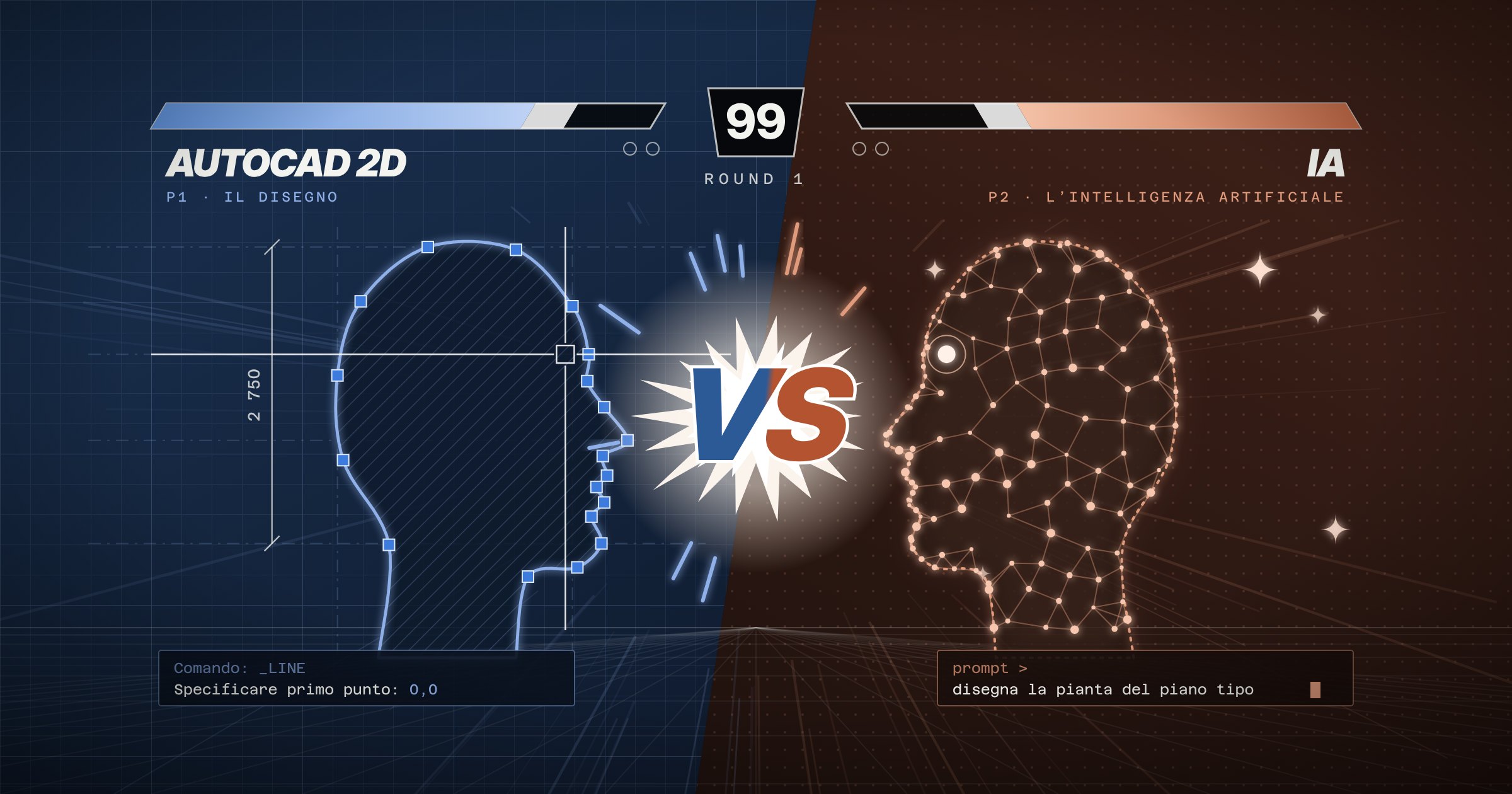
Let's start straight away with something that surprised me. The AutoCAD 2D volume of the Progetto e Calcolo series sold quite a bit more than I had counted on. And no, before anyone thinks it, I wasn't the one buying them (not all of them, at least).
Honestly, I didn't expect it. The same series has a volume on AI for design which, given the moment we're in, I thought would end up pulling the whole series along. Instead AutoCAD is keeping a very good average, almost on par with it. To be fair, I saw the AutoCAD handbook as the "utility" book: to put it in football terms, it's the holding midfielder: runs all game, everyone needs him, but the magazine cover always goes to the star striker.
And yet here we are.
I've thought about it for a while and I think I have an answer. The book is written for people who still have to do their first drawings, or are doing them right now: students, newly qualified technicians, people who need to hand in something readable by Friday and who, at that moment, couldn't care less about what the software will do in five years. What they need is to understand how to set up a file, why that line goes on that layer, how to dimension without making a mess, how to print a sheet that is actually at 1:100 and not maybe 1:100.
Boring stuff? A bit, I'll admit it. I've never met anyone who got excited setting up dimension or plot styles. But that's exactly where people get stuck, and after many years of using it I can say that's just how it is.
Drawing is how you make yourself understood#
Something I've learned over time, from technical school all the way to university, is that a drawing isn't a nice picture to hang in the living room. It's how you tell someone else what has to be built, and that someone (the contractor, a colleague, whoever checks the application) usually can't call you to ask what you meant, so you have to be clear. If a line weight is wrong or a dimension doesn't add up, the mistake doesn't stay on the sheet: sooner or later someone builds it exactly as drawn.
That's why I think basics like AutoCAD can't be skipped. You can have every tool you like, but if you can't read and write a technical drawing you'll notice eventually, and it usually happens at the worst possible moment, like the night before the deadline.
What about AI?#
I want to be clear here, because I'm not one of those people who think things were better in the days of the drafting board and the kneaded eraser. I use AI, I wrote a whole book about it (and we'll probably do a whole dedicated line of books within the series), and I think it will change our work for the better. It already saves a lot of time on repetitive tasks and helps with checking.
There's one detail, though. In the AI book every prompt has its own verification box, and that's on purpose: the result has to be checked by whoever signs it, not by the machine. To check a drawing made (or fixed) by an automatic tool you need to know what a correct drawing looks like, you need to spot straight away that the scale is off or that a layer has ended up with things that don't belong there. Or, an all-time classic, that everything was put on layer 0. If you've never done these things yourself, with a bit of patience, it's hard to see them when someone else does them for you.
Put simply, AI makes you faster. But whether the drawing is right or wrong is something you have to know, not least because the signature at the bottom of the sheet is yours, not its.
In my small way#
I don't have statistics and I don't want to draw big conclusions from a single book. It's a signal, nothing more. Still, it was nice to see that while everyone is talking about artificial intelligence, so many people decided to go back to 2D drawing.
I think they made the right call. Software changes every couple of years, the way you reason about a project a lot less, and people with solid basics adapt to whatever comes next, including programs that don't exist yet.
And for anyone looking at the cover and wondering: no, nobody wins by K.O. It ends in a draw, and I think that's just fine.
To everyone who bought the book: thank you, really. If you don't have it yet you'll find it just below, and the other volumes are on the publications page. Have a look at edizioniglyphe.it too.